Why upgrade if PQ signatures are not yet proven? The dirty secret of efforts to upgrade blockchains to post-quantum cryptography is that no one is sure if any of them work. None of the signatures being considered by major blockchains as quantum-resistant upgrades have been 100% proven to work. Until a quantum computer is invented, we won’t know for certain if they can successfully protect against an attack. Some may fall to an attack even before Q Day using existing computer technology. The National Institute of Standards and Technology tested 69 post-quantum candidate algorithms, and two of them — Rainbow and SIKE — were broken with classical computers during testing. The three digital signature schemes it recommends are its best guess as to which ones are most likely to survive a quantum attack. It selected the lattice-based CRYSTALS-Dilithium (ML-DSA) as the primary scheme, another lattice-based scheme called Falcon (FN-DSA) for use cases that demand smaller signatures an...

Bitcoiners are debating whether Bitcoin’s price would already be at $200,000 if not for the quantitative investment firm Jane Street messing around in the market.
“If only Jane Street wasn’t manipulating the markets, Bitcoin would have fully followed M2 money supply & we would be over $200k,” Coin Bureau CEO Nic Puckrin said in an X post.
It didn’t take much scrolling in the thread to know that he was being tongue-in-cheek.

Puckrin was making fun of the fact that plenty of Bitcoiners genuinely seem to think that’s the case right now. Bitcoiner Justin Bechler’s viral post detailing Jane Street’s alleged market manipulation tactics was seen by 5.4 million people and begins:
“Bitcoin should be at least $150,000 right now and everyone knows it.”
There are passionate advocates on both sides of the theory.
SmashFi CEO Brian HoonJong Paik said those who believe Jane Street is the sole reason for Bitcoin’s decline are “painfully naive.”
“The market is much bigger than one entity. Stop expecting a free pump,” Paik said.
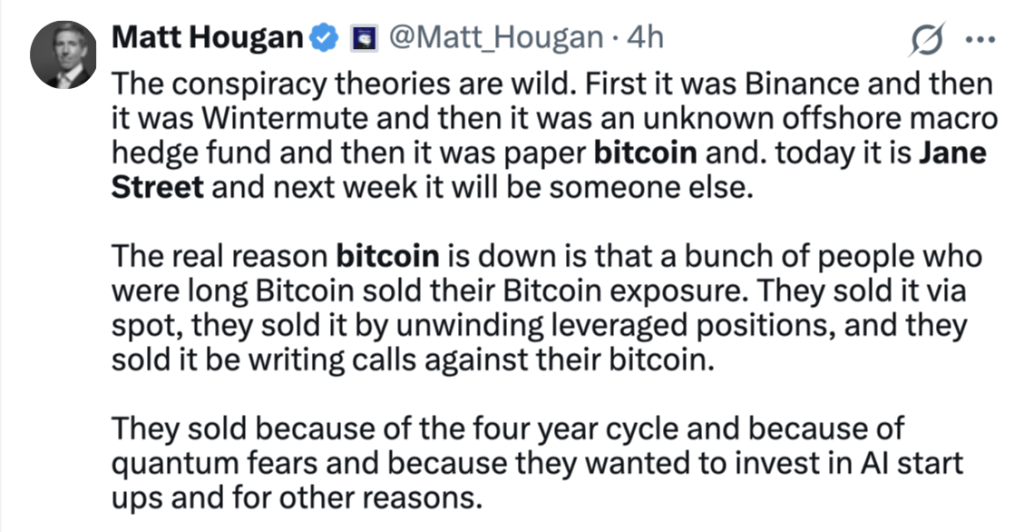
The reason Bitcoin started sliding after reaching $126K?
Interest in the topic of deliberate Bitcoin price suppression spiked this week after a theory circulated on social media among Bitcoiners linking Jane Street, which is now facing legalaction by thecourt-appointed administrator of the crypto company Terraform Labs, to the alleged coordination of algorithmic daily selling of Bitcoin at 10 a.m. ET.
The theory goes that the firm sold Bitcoin at the same time every day, pushing prices into liquidation zones, then bought back at lower levels and repeated the process daily. Some argued this was the main catalyst for months of Bitcoin downside beginning in October 2025. (There are other, more complicated theories, too, about how it might potentially manipulate markets.)
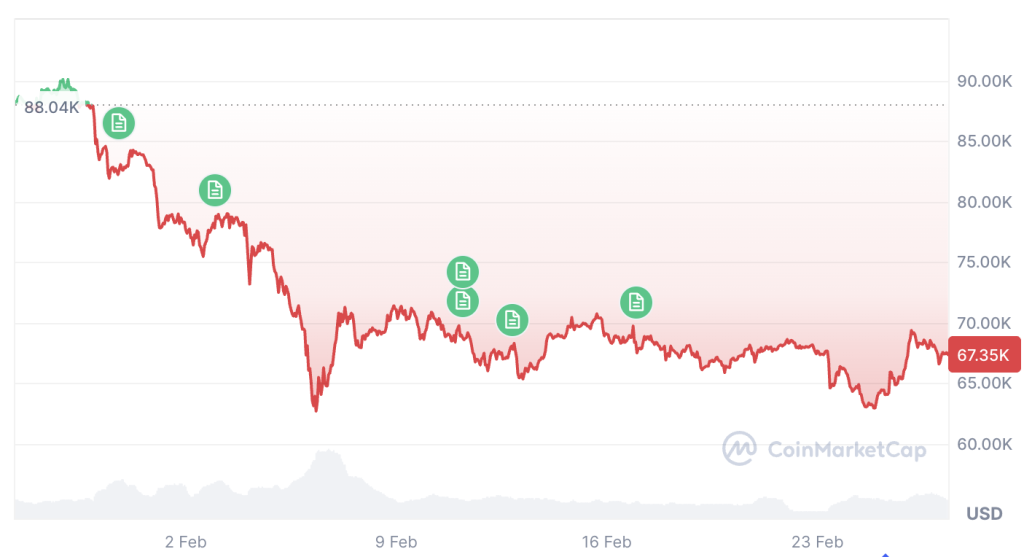
Bitcoin reached an all-time high of $126,100 on Oct. 5, only to be pushed down by a $19 billion crypto market liquidation event just days later on Oct. 10. It hit a multi-year low of $60,000 on Feb. 6 before edging slightly higher to $67,382 at the time of publication.
Many Bitcoiners remain convinced that Jane Street’s actions drove Bitcoin’s decline. It’s not hard to understand why, given that the firm trades trillions and its short and derivatives positions do not need to be disclosed. It’s very likely Jane Street has some impact on Bitcoin’s price, but the extent of that impact is hotly debated, and no one has proven there’s any manipulation.
Since December, Bitcoiner Matt McDonagh has been claiming that Jane Street manipulates Bitcoin’s price through a daily dumping-and-buying process. “Don’t listen to people saying ‘ it’s not possible to manipulate Bitcoin price’. Of course, that is EXACTLY what is going on,” McDonagh said in an X post.
Adding to the intrigue, Jane Street is one of only four firms allowed to create or redeem IBIT shares in-kind, alongside Virtu Americas, JP Morgan Securities and Marex. “This role gives the firm direct access to the mechanism that connects ETF share prices to actual Bitcoin,” Bechler said.
“Jane Street can move real Bitcoin into and out of the ETF structure, arbitrage price differences between the fund and the spot market, and maintain inventory positions that dwarf what any normal market participant could accumulate,” Bechler explained.
“Basically, Jane Street has direct access to the pipe that connects the Bitcoin ETF to actual Bitcoin, and almost nobody else does,” he added.
Read also
Features
Crypto kids fight Facebook for the soul of the Metaverse
Features
Blockchain Startups Think Justice Can Be Decentralized, but the Jury Is Still Out
Here’s why many have doubts about the Jane Street theory
BlockTower founder Ari Paul said that Jane Street’s actions would not have had a “meaningful change” on the asset’s price. He argued that market makers like Jane Street might nudge the price only in the very short term, but any impact would be minor.
“The price manipulation activities are typically small price moves, made and reverted quickly,” Paul said.
Paul claimed that the reason for the price falling was not Jane Street, but a much simpler one:
“Because OGs sold tens of thousands of coins, and not enough people wanted to buy them.”
Glassnode lead analyst James Check echoed a similar sentiment in an X post. “People. Sold. A. Fucktonne. Of. Spot. Bitcoin,” Check said.
In November, CryptoQuant data showed long-term holders sold more Bitcoin over the past three months than at any point since January 2024.
“Stop summoning your inner salty goldbug but blaming manipulators,” Check added.
Proof of Talent founder Rob Paone said, “If you believe the stuff about Jane Street dumping Bitcoin you probably have a lower SAT score than Gavin Newsom.”
But some anticipate that more allegations will come out soon. Crypto analyst Bark said, “this is just the first one to get caught so far… it’s about to get VERY interesting.”
- Get link
- X
- Other Apps
- Get link
- X
- Other Apps
Comments
Post a Comment